Few foods evoke more memories for Chinese from Hawai'i than Gau. For me, Gau is about waking up to the sound of firecrackers popping outside of my Popo Chun's temple at 6:00 am on Chinese New Year's Day. I'm five years old again and I wake up with the happy thought that if I run over to my Popo's house before school with my brother, Merrill, and wish her a "Gung Hee Fat Choy!" I will be rewarded with a leesee. This will contain the small fortune of a crisp $5.00 bill. In the mid 50's this amount would mean spending money for months into the future! So many things to consider: a new kite? a new yoyo? an Archie or Richie Rich comic? a wooden top to add to my growing collection? a gooey paper bag of apricot mui from Wing Coffee where my Aunty Wilma works?
Three foods were always present at Chinese New Year's. There was a huge Gau from my Popo, ten inches across, four inches high with sesame seeds sprinkled over the top and crowned with a single red date in the center. There was Jai, which I never cared for, once my older and supposedly wiser cousin solemnly informed me that the bok gwo, the white nuts, were actually frog's eyes. Not. It took me into my adult years before I tried Jai again and loved it. There was impossibly thin Jin Duey. So spoiled. I sometimes ate the sweet black bean-filled Jin Duey straight from the hot oil in my Popo's gigantic wok. Hot, crisp, perfect Jin Duey. Big Sigh!
It's 2008 and I've coordinated a gathering of Gau-proficient friends for Food Editor Wanda to meet for an Advertiser article. These happy women, in their forties to eighties, make and bring a total of 8 different kinds of Gau (most importantly, with treasured recipes!) to my friend, Elsie's, Aina Haina home. It started with an email from Wanda asking me Gau questions regarding my mother's recipe I'd emailed her last year. At least ostensibly it was supposed to be a Gau demo and exchange but it was, what every gathering of locals becomes, a PAR-TAY! Elsie repeatedly assured me that she wouldn't go through any trouble. I repeatedly assured her that we would take care of everything. Wanda brought all the ingredients from a detailed and far-flung products list. I was in charge of the hard ware, the mixing, steaming and baking equipment. Elsie said she would serve just "tea" for our little yum cha.
Well, Elsie made enough lunch for a small army although there were only 6 of us, plus, we all took home leftovers. She'd whipped up a huge layered overnight salad, her Aunt Bina's Portuguese Lima Bean Soup and date cake. All delicious, all from scratch. How do these women do that overnight? It's magic.
Elsie is a firecracker of a woman and at 88 with more energy than an 8 year old. Her friend, Gladys was so humble but a fount of Chinese lore and tradition. Sweet Cathy, who knows Elsie too, was the hard worker in the background making it so easy for us to do our tasks. Wanda was there with her camera, camcorder and notepad, asking astute questions to capture this moment. Deborah, the Advertiser photographer, arrived precisely an hour after the rest of us did, as planned, to give us the requisite time to talk story, exchange New Year presents and meet and greet.
The Gaus were all different but had the common denominator of being 'ono. Wanda brought a Shanghainese microwaved Gau chock full of red jujubes and pinenuts. This recipe was taught to her by the gal who teaches the Narcissus Queen participants. Cathy brought an unusual white Nian Gau from a Hanahau'oli cookbook. It had dried cherries and walnuts. I brought three versions of Gau from two recipes. There was the traditional steamed Gau with yams taught to me by my friend Susan 15 years ago. While steaming takes a minimum of 4 hours, I also baked the same batter for 1 hour. My mother's modern baked Gau with tsubushian that I brought was well received. Cathy and I made a modern steam/baked Gau with coconut milk during the gathering.
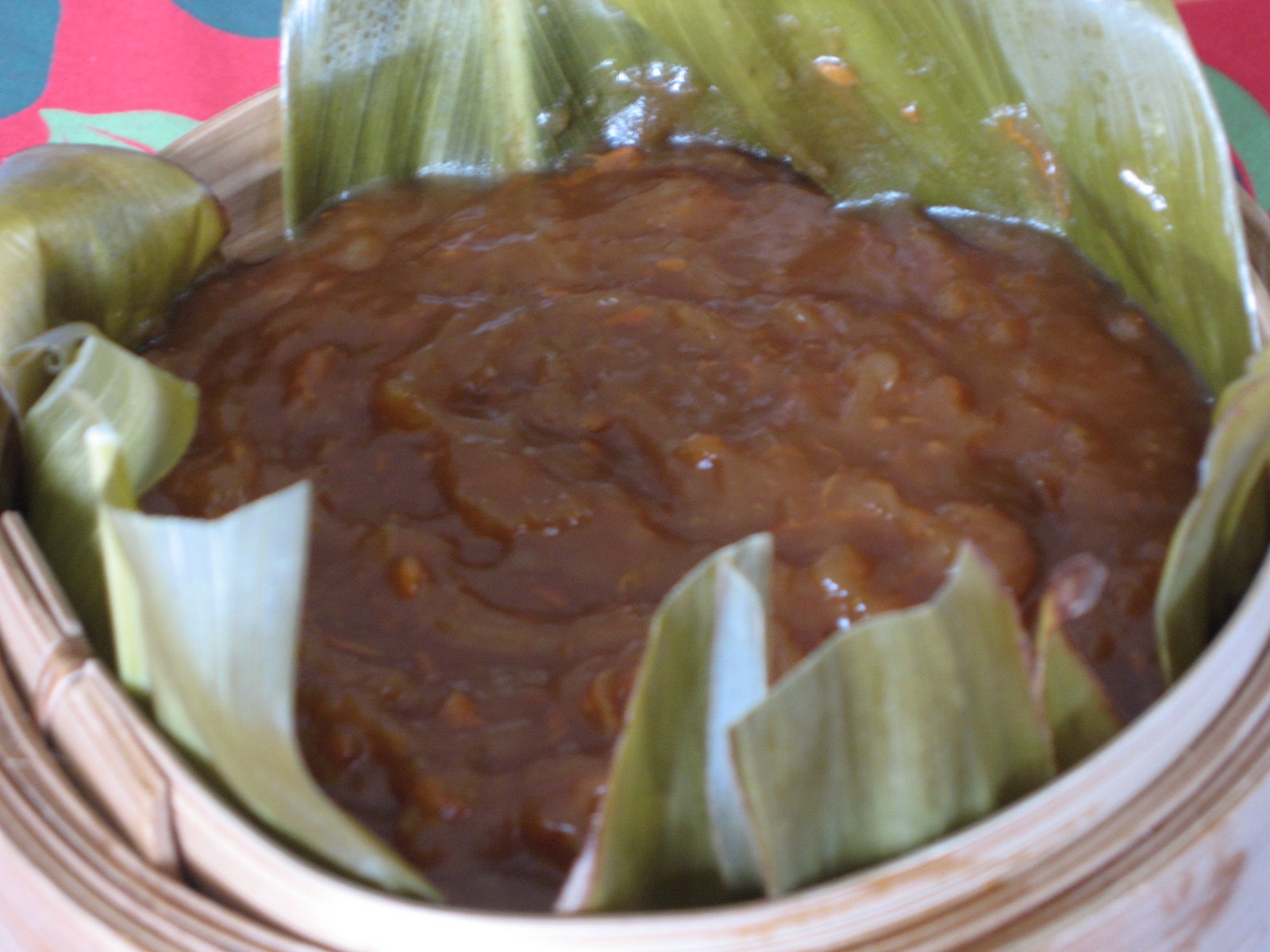
The main event was the involved and complicated process of making the traditional Gau by Gladys and Elsie. Cathy and I would take turns with mixing our simpler baked Gau in order to run back and forth to catch all the snippets of important information being generously doled out by Gladys and Elsie. First, they spent a half hour creating a ti leaf basket for the Gau to steam in. This was probably the first culinary nonstick surface. Then, they mixed the Gau batter by hand all the while relying on eye and instinct to determine the correct consistency. Elsie patiently watched the steaming pot for over 7 hours! Each procedure has its own distinct set of skills. We all felt very honored and humbled to be present to watch this re-creation of a favorite childhood sweet.
At lunch, we enjoyed (small) pieces of each of the many Gaus. Wanda brought a sample plate to the sophisicated palates of the Advertiser newsroom. I was so pleased to hear that my friend, Susan Chock's, traditionally steamed yam Gau turned out to be a favorite for both groups, that I raised both hands in the air and shouted "Yay!" as if I'd won an Olympic event!
-foodiewahine
Susan Chock's Gau
(Thank you Susan, for sharing your recipe, it's so precious to us!)
3 (1 lb.) boxes Mochiko
3 (1 lb.) packages of Wong Tong, Chinese brown sugar in blocks. 7 slabs to a pkg. Do not substitute regular brown sugar.
2 -3 lbs. fresh yams. No substitutions. Yams have a maroon skin, orange flesh.
3 cups water (opt.: Can add coconut milk but reduce water proportionately. Gau will then need refrigeration)
Washed ti leaves or dried bamboo leaves which are soaked for two days in water to soften.
Four 8" steaming baskets or pans
sesame seeds
Optional: 1 red date, Hung Jo, a jujube
The day before, cook yams with the peel on, in water to cover for approx. 45” until very soft or microwave. Peel, cool, set in the refrigerator overnight.
Melt brown sugar in 3 cups of water over medium heat until melted, about 15 min. Cool completely.
Line bamboo steamer containers with ti leaves in a circular pattern covering the steamer basket completely. May use string to create a collar.
Mash yams, taking out any large fibers or eyes. Mix sugar-water, mochiko and yams first with a wire whisk then by hand. This is like kneading. The batter should be like a stiff, very thick cake batter. You may have to add up to another 1 cup of water for the right consistency.
Place the batter into the steaming baskets that are lined with ti leaves. Place bamboo baskets in a pot for steaming over 1” of water. First bring to a boil then turn down to a high simmer but do not boil constantly. Place a thin dishtowel over the top of the pot under the lid. Check every hour to make sure that no water is dripping back down onto the gau during the steaming. Steam for 4 hours. Cool completely. A plastic knife will cut through the gau without dragging.
Servings: approximately 36
Note: you can cut the recipe by 1/3 by using 2 lbs. of mochiko, 2 blocks of sugar, etc. You can also use any available assortment of different sized baskets, cans and pans.
____________________________________________________________________
A HUGE Mahalo to Wanda, Elsie, Cathy, Gladys and Deborah for a wildly fun and successful Gau Fest. It would not have been possible without the generosity of those (Susan!) who shared their treasured family recipes.
Wanda Adam's informative and lively Gau-a-thon (her name for it) article with accompanying recipes, photos and video are on the Honolulu Advertiser's website for Jan. 23rd, 2008 in the Taste section.
Chinese New Year's falls on February 7 this year. Support your local Chinatowns.
____________________________________________________________________
Copyright 2007-2008. Anything to Eat. All rights reserved. This material and all material on this site may not be published, broadcast, rewritten or redistributed without permission. The author disclaims all liabilities in connection with the use of the information contained within.
Saturday, January 19, 2008


Monday, December 10, 2007
Soon Du Boo (also Sundubu), Spicy Korean Tofu Soup
Imagine a cold and wet night. Your slippers are soaked from dodging puddles on the street. Imagine serendipitously coming across a Korean restaurant that specializes in the delicious but little known (outside of Korean circles) boiling hot, bright red, tofu soup, Soon Du Boo. The restaurant is Duk Chang Do and is just across the street and mauka of Walgreen's on Keeaumoku. Ever since that night when I was Christmas shopping with my sister-in-law, Hedy, and my sister, Sherry, I've found myself craving Soon Du Boo whenever it rains. Haven't felt this strong an attraction, ok, addiction, to a soup since I first tasted Vietnamese Pho 15 years ago.
I felt compelled to thoroughly research how to make this soup and then I went right to the source, a Palama Market cashier. The cashier gave me an important tip. She advised me to use ko choo garu, the dry ground red chili pepper powder and NOT ko choo jang, the bottled red chili pepper sauce, to make Soon Du Boo.
I then had a looonng, informative and enjoyable conversation with my friend, KoreanWiz, (see link to her site at left) about the best Korean restaurants in Hawai'i and Korean food in general, I felt revitalized to continue my quest to make a decent Soon Du Boo. KoreanWiz just notified me that another spelling of Soon Du Boo is Sundubu.
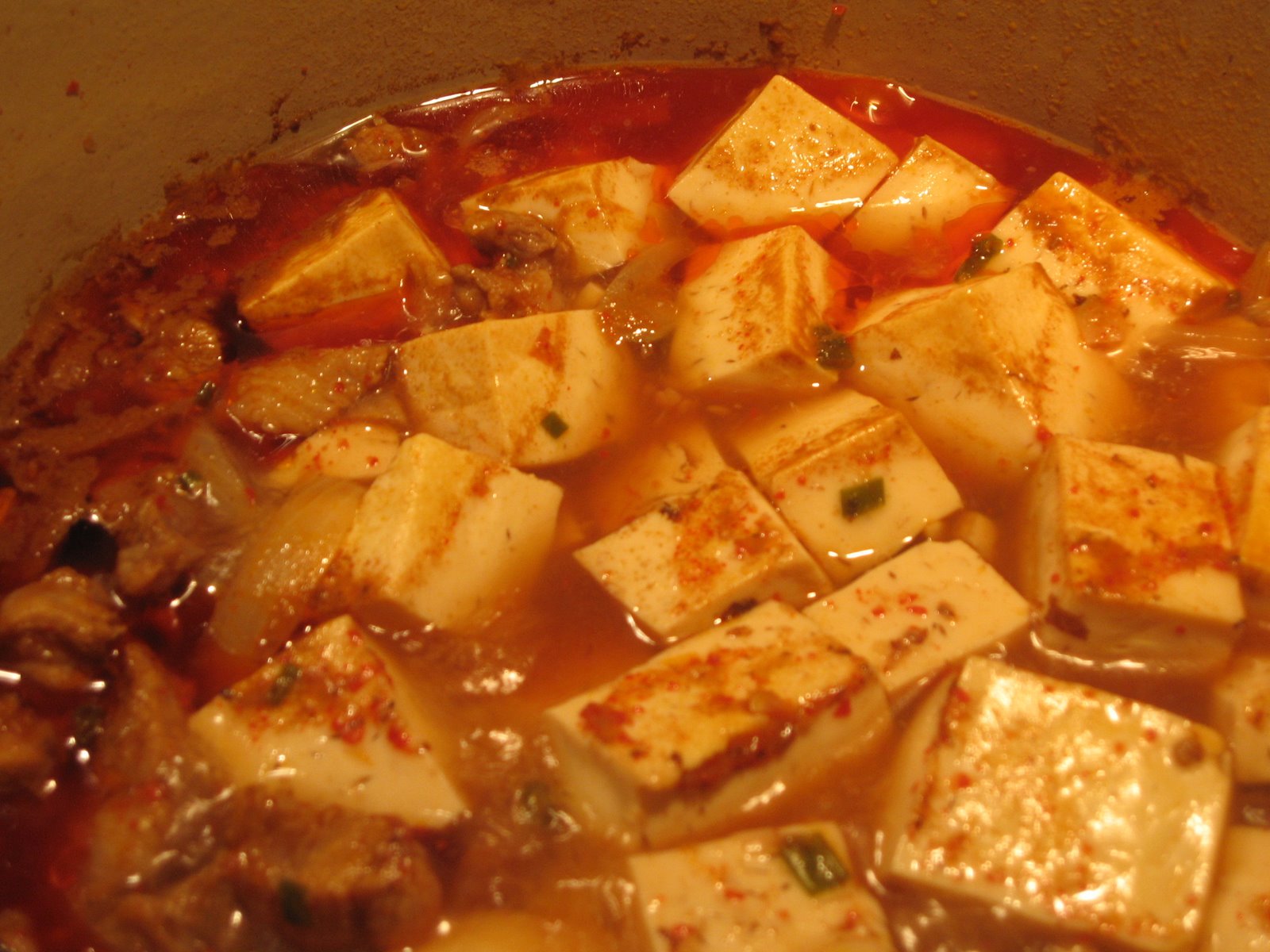
Several attempts later, following is my version of Soon Du Boo. Being Chinese, I had to add dried tangerine peel (kwo pay) because I feel it complements the spiciness well. I also like onions in my soup so I hope I am not committing heresy by including them here. While the soup is bright red it is not so much hot as pleasantly spicy.
You can make this into a meatless soup by using just tofu and substituting either vegetable broth or water for the chicken broth. This is one of those versatile soups that can be made with what's on hand. Please do not be put off by the list of ingredients. Most of these ingredients are generally on hand in local kitchens. The soup goes together faster than almost any other soup I can think of.
Soon Du Boo
also spelled "Sundubu"
photo at left on top
First create the sauce which will be divided into thirds and used for the meat or seafood marinade, the soup seasoning and then the dipping sauce (Yang Yohm Jjang):
2 T. ko choo garu (which is dry ground red chili pepper powder sold in large 1 lb. bags at Palama Market or Don Quixote. Do not substitute ko choo jang which is a bottled, seasoned red chili pepper sauce or red chili flakes, which would be too hot)
3-4 small red chili peppers with seeds, finely chopped
2 T. miso, Korean or Japanese
2 T. sesame oil
3 T. toasted sesame seeds, preferably ground with a sesame grinder. If you don't have a grinder you can use a mortar and pestle and absent that, a spoon and a bowl to crush the seeds.
3 T. soy sauce
3 cloves of garlic, peeled and mashed with the bottom of a cleaver or a spoon
1 tsp. sugar
3 green onions, sliced thinly
2 pcs. of dried tangerine peel
Combine the above and then divide equally into three small dishes, set aside.
Make the Soup.
1/2 to 1 lb. total weight of 3/4 inch cubed, boneless meat (pork, chicken, beef) and/or seafood (shrimp, mussels, clams) or a combination of both
1 round onion cut in the middle on the "equator" and then sliced into 1/8" slices from the stem to the "equator"
1 container of drained, silken or soft tofu, Soon Du Boo (I like House brand which is a Japanese tofu, widely available or you can use the authentic Korean tofu that comes in tubes at Palama Market) cut into 1 inch cubes
1 can of Swanson's chicken broth
1)Use the first portion of seasoning sauce to marinate the meat or seafood. Use your hands to massage the sauce in. Chill for at least 1/2 hour.
2)Using a Dutch oven or similar heavy pot, heat 2 T. of oil and 1 t. of sesame oil on High. Lightly brown first the onions and then the meat. Do not drain the marinade off the meat. Add the seafood last if you are using seafood.
3)Add the second portion of seasoning sauce with the tofu (careful not to break the cubes) and the broth over everything in the pot. Bring to a boil then turn down to a high simmer. Let cook for 1/2 hour with a lid on.
Serve the soup with a bowl of hot white rice and the remaining third of the seasoning sauce in a small dish for dipping.
Strictly optional, but the traditional way to serve this, is by dropping a raw egg onto the bubbling and boiling soup when it's brought to the table in an earthenware or cast iron vessel. Can garnish with more sliced green onions and strips of grilled meats like bulgogi, kal bi, pork or chicken.
-foodiewahine
____________________________________________________________________
A big Mahalo to KoreanWiz for linking my blogsite to her website and mentioning this recipe! If you are at all interested in Korean tv dramas, her site is THE place to go. KoreanWiz started her website six years ago before the English-speaking world caught the craze.
I felt compelled to thoroughly research how to make this soup and then I went right to the source, a Palama Market cashier. The cashier gave me an important tip. She advised me to use ko choo garu, the dry ground red chili pepper powder and NOT ko choo jang, the bottled red chili pepper sauce, to make Soon Du Boo.
I then had a looonng, informative and enjoyable conversation with my friend, KoreanWiz, (see link to her site at left) about the best Korean restaurants in Hawai'i and Korean food in general, I felt revitalized to continue my quest to make a decent Soon Du Boo. KoreanWiz just notified me that another spelling of Soon Du Boo is Sundubu.
Several attempts later, following is my version of Soon Du Boo. Being Chinese, I had to add dried tangerine peel (kwo pay) because I feel it complements the spiciness well. I also like onions in my soup so I hope I am not committing heresy by including them here. While the soup is bright red it is not so much hot as pleasantly spicy.
You can make this into a meatless soup by using just tofu and substituting either vegetable broth or water for the chicken broth. This is one of those versatile soups that can be made with what's on hand. Please do not be put off by the list of ingredients. Most of these ingredients are generally on hand in local kitchens. The soup goes together faster than almost any other soup I can think of.
Soon Du Boo
also spelled "Sundubu"
photo at left on top
First create the sauce which will be divided into thirds and used for the meat or seafood marinade, the soup seasoning and then the dipping sauce (Yang Yohm Jjang):
2 T. ko choo garu (which is dry ground red chili pepper powder sold in large 1 lb. bags at Palama Market or Don Quixote. Do not substitute ko choo jang which is a bottled, seasoned red chili pepper sauce or red chili flakes, which would be too hot)
3-4 small red chili peppers with seeds, finely chopped
2 T. miso, Korean or Japanese
2 T. sesame oil
3 T. toasted sesame seeds, preferably ground with a sesame grinder. If you don't have a grinder you can use a mortar and pestle and absent that, a spoon and a bowl to crush the seeds.
3 T. soy sauce
3 cloves of garlic, peeled and mashed with the bottom of a cleaver or a spoon
1 tsp. sugar
3 green onions, sliced thinly
2 pcs. of dried tangerine peel
Combine the above and then divide equally into three small dishes, set aside.
Make the Soup.
1/2 to 1 lb. total weight of 3/4 inch cubed, boneless meat (pork, chicken, beef) and/or seafood (shrimp, mussels, clams) or a combination of both
1 round onion cut in the middle on the "equator" and then sliced into 1/8" slices from the stem to the "equator"
1 container of drained, silken or soft tofu, Soon Du Boo (I like House brand which is a Japanese tofu, widely available or you can use the authentic Korean tofu that comes in tubes at Palama Market) cut into 1 inch cubes
1 can of Swanson's chicken broth
1)Use the first portion of seasoning sauce to marinate the meat or seafood. Use your hands to massage the sauce in. Chill for at least 1/2 hour.
2)Using a Dutch oven or similar heavy pot, heat 2 T. of oil and 1 t. of sesame oil on High. Lightly brown first the onions and then the meat. Do not drain the marinade off the meat. Add the seafood last if you are using seafood.
3)Add the second portion of seasoning sauce with the tofu (careful not to break the cubes) and the broth over everything in the pot. Bring to a boil then turn down to a high simmer. Let cook for 1/2 hour with a lid on.
Serve the soup with a bowl of hot white rice and the remaining third of the seasoning sauce in a small dish for dipping.
Strictly optional, but the traditional way to serve this, is by dropping a raw egg onto the bubbling and boiling soup when it's brought to the table in an earthenware or cast iron vessel. Can garnish with more sliced green onions and strips of grilled meats like bulgogi, kal bi, pork or chicken.
-foodiewahine
____________________________________________________________________
A big Mahalo to KoreanWiz for linking my blogsite to her website and mentioning this recipe! If you are at all interested in Korean tv dramas, her site is THE place to go. KoreanWiz started her website six years ago before the English-speaking world caught the craze.
Saturday, November 17, 2007
"Entertaining Island Style" by Wanda A. Adams
Wanda Adams, the Food and Book editor to the Honolulu Advertiser, has just come out with her second cookbook "Entertaining Island Style-101 Great Recipes and Tips from Hawai'i". I know I may be biased because I worked on the photoshoot but I think it's terrific. Fabulous job on the photos by the photographer and the styling team. I think these local recipes are inventive and most importantly, delicious. These recipes have been thoroughly tested and come out exactly as described. Wanda thoughtfully provided ingredient substitutions for mainland folk.
Wanda's first cookbook "Island Plate" quickly sold out its first three editions and is in its fourth printing. Both cookbooks are available on amazon.com. ( Entertaining Island Style is 10. on amazon.com If you order 25. or more in books then shipping is FREE, even to Hawai'i!) and bookstores locally. At the end of this post is the description of her second cookbook from Borders online.
It was great fun to work on the shoot and I learned alot from the food and photo pros on the crew. My cousin, EB, asked me for a list of favorite recipes I've tried from the book so far (I got a sheaf of some of the recipes earlier when working on the shoot):
Cozido Soup, Portuguese Kale and Sausage p. 47 (hearty and quick)
Nibuta Pork p. 71 (great sliced over saimin, ramen)
Furikake Salmon p. 77 (very popular restaurant item)
Okazuya Style Fish Cake p. 107 (from a previous Advertiser article)
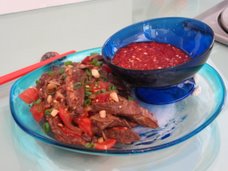
Steak Poke p.124 (Hand's down winnah. Wanda said she made it for a tv appearance on Andy Bumatai and the tv crew wiped it out. Photo on the top left of this posting)
Prune Cake and 7 min. icing p. 129 and 130 (moist, better even the next day when the spices have time to mellow)
Soft Haupia Custard p. 132 (very yummy, very versatile sauce or filling for cakes, etc.)
Pineapple Cream Cheese Pie p. 144 (my favorite dessert from the book)
Swedish Crepes p. 149 (easy, perfect crepes)
-foodiewahine
Borders' description on their site of Wanda's cookbook:
Entertaining Island StyleBibliographic Data: Hardcover, 24 Pages, December 2007Author: Adams, Wanda A.List Price: $15.
Everyone loves a luau! And with the help of "Entertaining Island Style, " it's easy to host a Hawaiian-themed bash that's both authentic and enjoyable. This playful, insightful guide is a one-stop resource for Island culture, customs, and cooking. Written by Maui native Wanda Adams, it features the low-down on local parties -- what's done, what's not done, what types of food and beverages are served; easy-to-understand descriptions of local food terms; and must-have details such as how to crack a coconut. A wealth of fabulous recipes, all Island favorites, reflect the diverse cultures and flavors of the people of Hawaii. Adams also offers fascinating historical facts on the origins of tropical drinks, along with a bevy of luscious cocktail recipes. Whether prepared for a crowd or a simple weeknight supper, these fresh, exciting recipes make any occasion a sunny one.
_________________________________________________________________
Wanda Adams wrote an article on Nov. 7, 2007 for the Advertiser about her new book. It can be found on the Honolulu Advertiser website in the archives for that date. She provides her recipe for Steak Poke. There are also video clips of her preparing dishes from the cookbook.
____________________________________________________________________
A hello to Cindy N. and her friends! Cindy and I ran into each other at Sunnyside in Wahiawa. She'd read my blog and asked me if I was a vegetarian now? NOT! She was too polite to notice that I'd ordered the fried rice special with sunnyside up egg and a hot dog! BUSTED! Note to Dr. S and Dr. D, I really don't eat this way all the time. In fact, I know I've adopted the Shintani lifestyle 80% of the time.
Another hello to the Mo'ili'ili McD's group: Carlson, Linda, Ron, Sharon, Fred, Jenna, Joe, Leila and John! It was great to finally meet the rest of the gang. You guys are loyal friends to each other.
Wanda's first cookbook "Island Plate" quickly sold out its first three editions and is in its fourth printing. Both cookbooks are available on amazon.com. ( Entertaining Island Style is 10. on amazon.com If you order 25. or more in books then shipping is FREE, even to Hawai'i!) and bookstores locally. At the end of this post is the description of her second cookbook from Borders online.
It was great fun to work on the shoot and I learned alot from the food and photo pros on the crew. My cousin, EB, asked me for a list of favorite recipes I've tried from the book so far (I got a sheaf of some of the recipes earlier when working on the shoot):
Cozido Soup, Portuguese Kale and Sausage p. 47 (hearty and quick)
Nibuta Pork p. 71 (great sliced over saimin, ramen)
Furikake Salmon p. 77 (very popular restaurant item)
Okazuya Style Fish Cake p. 107 (from a previous Advertiser article)
Steak Poke p.124 (Hand's down winnah. Wanda said she made it for a tv appearance on Andy Bumatai and the tv crew wiped it out. Photo on the top left of this posting)
Prune Cake and 7 min. icing p. 129 and 130 (moist, better even the next day when the spices have time to mellow)
Soft Haupia Custard p. 132 (very yummy, very versatile sauce or filling for cakes, etc.)
Pineapple Cream Cheese Pie p. 144 (my favorite dessert from the book)
Swedish Crepes p. 149 (easy, perfect crepes)
-foodiewahine
Borders' description on their site of Wanda's cookbook:
Entertaining Island StyleBibliographic Data: Hardcover, 24 Pages, December 2007Author: Adams, Wanda A.List Price: $15.
Everyone loves a luau! And with the help of "Entertaining Island Style, " it's easy to host a Hawaiian-themed bash that's both authentic and enjoyable. This playful, insightful guide is a one-stop resource for Island culture, customs, and cooking. Written by Maui native Wanda Adams, it features the low-down on local parties -- what's done, what's not done, what types of food and beverages are served; easy-to-understand descriptions of local food terms; and must-have details such as how to crack a coconut. A wealth of fabulous recipes, all Island favorites, reflect the diverse cultures and flavors of the people of Hawaii. Adams also offers fascinating historical facts on the origins of tropical drinks, along with a bevy of luscious cocktail recipes. Whether prepared for a crowd or a simple weeknight supper, these fresh, exciting recipes make any occasion a sunny one.
_________________________________________________________________
Wanda Adams wrote an article on Nov. 7, 2007 for the Advertiser about her new book. It can be found on the Honolulu Advertiser website in the archives for that date. She provides her recipe for Steak Poke. There are also video clips of her preparing dishes from the cookbook.
____________________________________________________________________
A hello to Cindy N. and her friends! Cindy and I ran into each other at Sunnyside in Wahiawa. She'd read my blog and asked me if I was a vegetarian now? NOT! She was too polite to notice that I'd ordered the fried rice special with sunnyside up egg and a hot dog! BUSTED! Note to Dr. S and Dr. D, I really don't eat this way all the time. In fact, I know I've adopted the Shintani lifestyle 80% of the time.
Another hello to the Mo'ili'ili McD's group: Carlson, Linda, Ron, Sharon, Fred, Jenna, Joe, Leila and John! It was great to finally meet the rest of the gang. You guys are loyal friends to each other.
Friday, November 2, 2007
Dr. Shintani's Spicy Tofu Nuggets
This is an EASY and flavorful entree that is also very versatile. In Sherry's and my opinion it was definitely one of the enlightening hits at the Shintani workshop on Oct. 13. Dr. Diane graciously obtained permission for me to print it. Once you get the method down it will be a snap for you to change the spices to suit the dish you are making and your tastes.
Note: My high techno-savvy brother-in-law taught me that the easiest way to print out these recipes from the blog is Cut and Paste it. That is, first, highlight it, hit the Cut button under Edit at the top of the screen, close down the site, go into the Word program and hit Paste under Edit.
Spicy Tofu Nuggets
Adapted from Dr. Shintani’s diet books
1 block firm or extra-firm tofu
¼ c. flour, whole wheat or white, mixed with 1 tsp. Spike and other spices, e.g., 1 tsp. tumeric
2 tsp. canola or olive oil
1 tsp. sesame oil
1 –2 tsp. shoyu or Bragg’s liquid aminos (health food store)
2 tsp. nutritional yeast (health food store, optional, but good, can be bought in bulk at Down to Earth)
1 tsp. low salt furikake
Tofu is a plant based product. All plant based products have to be browned on a slightly lower heat than any meat. Best never to use high heat unless used briefly. It will take a bit longer so you need to watch the pan.
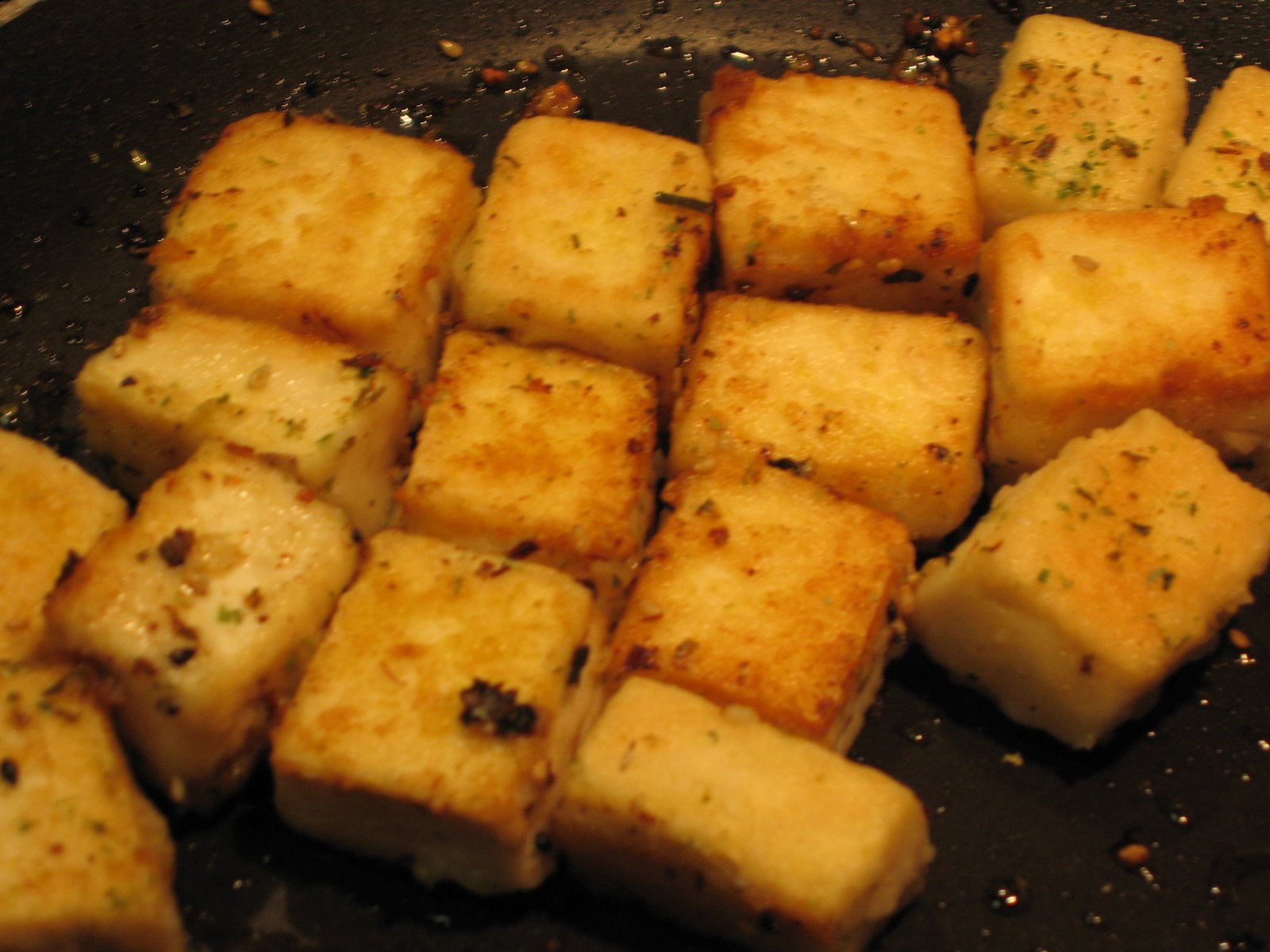
Drain tofu thoroughly and wrap in a paper towel or dish towel to absorb excess water. Cut tofu into 1 inch blocks. Dredge each tofu cube individually in the flour mixture. Keep dry. Heat a nonstick pan with a thin film of both oils on Medium heat. Place the cubes in the pan. Sprinkle the cubes with the shoyu or Bragg's. Brown tofu gently on all sides on Medium heat. A High heat may scorch the tofu.
Add the nutritional yeast and the furikake. Toss to coat evenly. Can deglaze the pan with 2 tsp. of water or broth so that the nuggets are a bit moist or leave dry according to your preference.
You can serve the nuggets with a dipping sauce or as is. A simple dipping sauce would be equal parts shoyu and sesame oil with a light sprinkle of shichimi togarashi or cayenne. Save any leftovers to be used in soups, stews, sandwiches, spaghetti, chili, etc., either whole or broken up.
You could also cut the tofu into slabs like tofu steaks and prepare the same way as the cubes. My friend, Wanda, reported that the spicy tofu works well in long strips in a Vegetarian Spring Roll.
Serve with brown rice. Soak raw rice at least 4 hours for the best consistency prior to cooking. Cook in rice cooker with slightly more water than indicated on the correct water level on the rice cooker pot. Fluff the rice with a nonstick rice paddle prior to serving.
Note: My high techno-savvy brother-in-law taught me that the easiest way to print out these recipes from the blog is Cut and Paste it. That is, first, highlight it, hit the Cut button under Edit at the top of the screen, close down the site, go into the Word program and hit Paste under Edit.
Spicy Tofu Nuggets
Adapted from Dr. Shintani’s diet books
1 block firm or extra-firm tofu
¼ c. flour, whole wheat or white, mixed with 1 tsp. Spike and other spices, e.g., 1 tsp. tumeric
2 tsp. canola or olive oil
1 tsp. sesame oil
1 –2 tsp. shoyu or Bragg’s liquid aminos (health food store)
2 tsp. nutritional yeast (health food store, optional, but good, can be bought in bulk at Down to Earth)
1 tsp. low salt furikake
Tofu is a plant based product. All plant based products have to be browned on a slightly lower heat than any meat. Best never to use high heat unless used briefly. It will take a bit longer so you need to watch the pan.
Drain tofu thoroughly and wrap in a paper towel or dish towel to absorb excess water. Cut tofu into 1 inch blocks. Dredge each tofu cube individually in the flour mixture. Keep dry. Heat a nonstick pan with a thin film of both oils on Medium heat. Place the cubes in the pan. Sprinkle the cubes with the shoyu or Bragg's. Brown tofu gently on all sides on Medium heat. A High heat may scorch the tofu.
Add the nutritional yeast and the furikake. Toss to coat evenly. Can deglaze the pan with 2 tsp. of water or broth so that the nuggets are a bit moist or leave dry according to your preference.
You can serve the nuggets with a dipping sauce or as is. A simple dipping sauce would be equal parts shoyu and sesame oil with a light sprinkle of shichimi togarashi or cayenne. Save any leftovers to be used in soups, stews, sandwiches, spaghetti, chili, etc., either whole or broken up.
You could also cut the tofu into slabs like tofu steaks and prepare the same way as the cubes. My friend, Wanda, reported that the spicy tofu works well in long strips in a Vegetarian Spring Roll.
Serve with brown rice. Soak raw rice at least 4 hours for the best consistency prior to cooking. Cook in rice cooker with slightly more water than indicated on the correct water level on the rice cooker pot. Fluff the rice with a nonstick rice paddle prior to serving.
Sunday, October 28, 2007
Shintani Lifestyle and Diet
Dr. Terry Shintani held one of his last 4 hour seminars two weeks ago. My sister, Sherry, and I count ourselves as lucky for being in attendance. Dr. Diane, the Administrator of the Hawai'i Health Foundation, the non-profit that runs the seminars, explained that the next two events, a Nov. 3, 2007 10 Day Program and a Feb., 2008 21 Day Program may be the last ones that Dr. Shintani does. So, Sherry and I felt very fortunate to be able to hear Dr. Shintani live.
Dr. Shintani is very well known for his groundbreaking work with diet not only in Hawai'i but globally. His book "The Hawai'i Diet" was on the NY Times bestseller list. He has a medical and a law degree from the UH and a Masters in Nutrition from Harvard. He's listed in the Encyclopedia Britannica. He's appeared on national television news shows. For more of his background you can go to the website which Dr. Diane designed and maintains at webhealthforyou.com/home
You know I am interested in anything to do with food. Some minor health problems prompted me to attend the seminar. My thought was that while I may never become a strict vegetarian, more knowledge would help me in making healthier choices in my food. I think Sherry and I got much more than we bargained for, in a good way.
Basically, if I were to sum up Dr. Shintani's diet plan (Sorry, Dr. Shintani if I use my own mana'o and words) I would say that it is a non-diet. It is a change in lifestyle which actually frees you to eat probably more types of food and a larger volume of food if that is what you want. It is a holistic approach that focuses on diet but includes exercise, our spiritual life, our attitudes, our beliefs and even our feelings of self-worth.
Dr. S. says that on average we need about 2,500 calories a day to maintain our weight with some differences depending on gender, weight, body type, activity, etc. It is better for our bodies if we put into it 2,500 calories of whole grains, low fat, plant based proteins, vegetables and fruits instead of refined flours, sugars and processed foods (think of the movie "Supersize Me"). He likes to say Junk In, Junk Out.
His books provide the Shintani Mass Index of Food which helps you to easily identify which foods are high in nutrition and low in the things that are bad for you, namely fats, animal based protein and refined processed food. As an example, it would take pounds and pounds of say, broccoli to reach 2,500 calories but only one or two meals of fast food. Maybe two cheeseburgers and two shakes. And, most importantly the former will fill up your stomach and make you full but the latter will leave you hungry for more if that is all you ate in one day. Dr. Shintani just uses examples with one food as with broccoli as a lesson, he promotes a widely varied and balanced daily diet. Everything in moderation.
Dr. Shintani, Dr. Diane, Down to Earth and many volunteers put on an enlightening seminar that is part instructional lectures, part cooking show and totally entertaining. Dr. Shintani's beliefs are firmly founded on scientific proof as well as common sense and stories of his many years in practice which includes years at the Waianae Coast Comprehensive Health Center. It is not an exaggeration to say that Sherry and I were astonished when we tasted the samples of breakfast, lunch and dinner which we were served. I had heard that people make scrambled tofu but until I actually tried it I didn't understand the concept. Sherry was especially taken with the Spicy Tofu Nuggets. These dishes were representative of the actually yummy, local, some Asian, some Pacific Rim recipes found in three of his books "Eat More, Weigh Less Diet" "Eat More, Weigh Less Cookbook" and "The Hawai'i Diet" by Dr. Terry Shintani.
So, here I am on Day 16 of my own version of the Dr. Shintani lifestyle. While Dr. Shintani and his family are vegans (no dairy, no eggs, no meat) he does not push his choices on you but offers an option and we are, of course, free to make our own food choices. No food police in my kitchen!
My diet these last couple of weeks has consisted of primarily plant based foods but sometimes up to 6 oz. of some form of meat a day. There was that birthday dinner last Friday at Mei Sum of scrumptious dim sum but surprisingly I found myself craving my whole grains by the following morning. The diet does make me feel better. It's hard to put my finger on, I just feel lighter like the difference between having some virtuous jai or oden and having a not-so-virtuous prime rib dinner.
OK, confession time. There are MANY health benefits to the Shintani Diet and it is a relatively easy way to lose weight but there were some pretty convincing Before and After the 21 Day program photos in a slideshow too. It was amazing that the women in particular in their After photos looked like the photo had been taken 10 years ago when they were younger! Well, a skeptic could say that the photos were altered. Not so! There were live, short testimonials at the seminar we attended and those same women in person look every bit as good, if not better, than when the last photos were taken, a year or more ago. How about that?!
-foodiewahine
ps: I made the Jim Lahey No Knead Bread recipe, below, using 2 c. bread flour and 1 cup stone ground whole wheat flour and it was great. I'll try flaxseeds, oat bran add-ins in the future and report. I'll keep you posted on the lifestyle changes and will add recipes in the future.
another ps: I'm not giving up my square of dark chocolate a day.
_____________________________________________________________________
This blog is written as a thank you to the tireless efforts of Dr. Shintani, Dr. Diane and volunteers who are passionate about their vision for healthier lives. A thank you to Sherry for going with me to the seminar and for her ongoing support and enthusiasm.
"Eat More, Weigh Less Diet", "Eat More, Weigh Less Cookbook" and "The Hawaii Diet" by Dr. Terry Shintani, MD, JD, MPH, as well as ebooks, other books and videos are all available from webhealthandyou.com, Dr. Shintani's website. See link to the left of this posting. A number of Dr. Shintani's eight books are also available on amazon.com
Dr. Shintani is very well known for his groundbreaking work with diet not only in Hawai'i but globally. His book "The Hawai'i Diet" was on the NY Times bestseller list. He has a medical and a law degree from the UH and a Masters in Nutrition from Harvard. He's listed in the Encyclopedia Britannica. He's appeared on national television news shows. For more of his background you can go to the website which Dr. Diane designed and maintains at webhealthforyou.com/home
You know I am interested in anything to do with food. Some minor health problems prompted me to attend the seminar. My thought was that while I may never become a strict vegetarian, more knowledge would help me in making healthier choices in my food. I think Sherry and I got much more than we bargained for, in a good way.
Basically, if I were to sum up Dr. Shintani's diet plan (Sorry, Dr. Shintani if I use my own mana'o and words) I would say that it is a non-diet. It is a change in lifestyle which actually frees you to eat probably more types of food and a larger volume of food if that is what you want. It is a holistic approach that focuses on diet but includes exercise, our spiritual life, our attitudes, our beliefs and even our feelings of self-worth.
Dr. S. says that on average we need about 2,500 calories a day to maintain our weight with some differences depending on gender, weight, body type, activity, etc. It is better for our bodies if we put into it 2,500 calories of whole grains, low fat, plant based proteins, vegetables and fruits instead of refined flours, sugars and processed foods (think of the movie "Supersize Me"). He likes to say Junk In, Junk Out.
His books provide the Shintani Mass Index of Food which helps you to easily identify which foods are high in nutrition and low in the things that are bad for you, namely fats, animal based protein and refined processed food. As an example, it would take pounds and pounds of say, broccoli to reach 2,500 calories but only one or two meals of fast food. Maybe two cheeseburgers and two shakes. And, most importantly the former will fill up your stomach and make you full but the latter will leave you hungry for more if that is all you ate in one day. Dr. Shintani just uses examples with one food as with broccoli as a lesson, he promotes a widely varied and balanced daily diet. Everything in moderation.
Dr. Shintani, Dr. Diane, Down to Earth and many volunteers put on an enlightening seminar that is part instructional lectures, part cooking show and totally entertaining. Dr. Shintani's beliefs are firmly founded on scientific proof as well as common sense and stories of his many years in practice which includes years at the Waianae Coast Comprehensive Health Center. It is not an exaggeration to say that Sherry and I were astonished when we tasted the samples of breakfast, lunch and dinner which we were served. I had heard that people make scrambled tofu but until I actually tried it I didn't understand the concept. Sherry was especially taken with the Spicy Tofu Nuggets. These dishes were representative of the actually yummy, local, some Asian, some Pacific Rim recipes found in three of his books "Eat More, Weigh Less Diet" "Eat More, Weigh Less Cookbook" and "The Hawai'i Diet" by Dr. Terry Shintani.
So, here I am on Day 16 of my own version of the Dr. Shintani lifestyle. While Dr. Shintani and his family are vegans (no dairy, no eggs, no meat) he does not push his choices on you but offers an option and we are, of course, free to make our own food choices. No food police in my kitchen!
My diet these last couple of weeks has consisted of primarily plant based foods but sometimes up to 6 oz. of some form of meat a day. There was that birthday dinner last Friday at Mei Sum of scrumptious dim sum but surprisingly I found myself craving my whole grains by the following morning. The diet does make me feel better. It's hard to put my finger on, I just feel lighter like the difference between having some virtuous jai or oden and having a not-so-virtuous prime rib dinner.
OK, confession time. There are MANY health benefits to the Shintani Diet and it is a relatively easy way to lose weight but there were some pretty convincing Before and After the 21 Day program photos in a slideshow too. It was amazing that the women in particular in their After photos looked like the photo had been taken 10 years ago when they were younger! Well, a skeptic could say that the photos were altered. Not so! There were live, short testimonials at the seminar we attended and those same women in person look every bit as good, if not better, than when the last photos were taken, a year or more ago. How about that?!
-foodiewahine
ps: I made the Jim Lahey No Knead Bread recipe, below, using 2 c. bread flour and 1 cup stone ground whole wheat flour and it was great. I'll try flaxseeds, oat bran add-ins in the future and report. I'll keep you posted on the lifestyle changes and will add recipes in the future.
another ps: I'm not giving up my square of dark chocolate a day.
_____________________________________________________________________
This blog is written as a thank you to the tireless efforts of Dr. Shintani, Dr. Diane and volunteers who are passionate about their vision for healthier lives. A thank you to Sherry for going with me to the seminar and for her ongoing support and enthusiasm.
"Eat More, Weigh Less Diet", "Eat More, Weigh Less Cookbook" and "The Hawaii Diet" by Dr. Terry Shintani, MD, JD, MPH, as well as ebooks, other books and videos are all available from webhealthandyou.com, Dr. Shintani's website. See link to the left of this posting. A number of Dr. Shintani's eight books are also available on amazon.com
Tuesday, August 7, 2007
Jim Lahey's Amazing Bread Recipe
The bread recipe I'm going to pass on is nothing short of wonderful. I don't impress easily. I've read thousands of recipes but this one seemed too good to be true. A simple bread recipe that you don't have to knead and, according to Jim Lahey, the professional baker who created it, rivals any commercially made bread in the country?
My LA pastry chef/instructor friend, Tina, (Mahalo plennny, Sistah!) sent me a link, several days ago, to an article written on 8 November of 2006 in the NY Times by Mark Bittman titled "The Secret of Great Bread: Let Time Do the Work". The recipe and the accompanying video about Lahey's recipe sounded and looked intriguing. Water, flour, yeast and salt and no special equipment? Perfect, artisinal style French bread? Tell me more!
My first attempt made with regular white flour in a 3.5 qt., stainless steel Belgique stockpot flattened out too much and did not have sufficient structure. I let it rise the full 18 hours. The bread did show promise. Do you know how really great French bread tastes cool as if it had been in the fridge? I have no other way to describe it. This bread has that. It had a great crumb, shattering crust and an almost sourdough taste. I just needed to find a good substitute for the heavy enamel Le Creuset pots that Jim Lahey uses to create the steam needed. Steam is important to make the dough rise properly and to create that great crust in the oven.
On my second try, I changed the regular flour to bread flour and baked the dough in a heavy Pyrex mixing bowl which is narrower on the bottom than the top. This feature is necessary to create height in the bread. I placed the Pyrex bowl in a covered terra cotta roaster to create the steam oven effect. The roaster also protects the Pyrex which can shatter at temperatures over 350 degrees. I then placed this whole baking set up on a pizza stone for extra insulation. Since our room temperature is about 80 degrees now, in the summer, I experimented and cut the first rise to just 4 hours. The flavor was less like sourdough and more like regular French bread but still very good. The extra long rising, as in my first attempt, ferments the dough. At left you see the results of my second attempt. Without a doubt it is the best French Boule I've ever made.
It is critical that you use the correct baking vessel or a combination of baking pieces to create a mini steam oven. Jim Lahey suggests using a cast iron, enamel, Pyrex or ceramic vessel for baking. It must have a cover and it must be thick and heavy. It should be narrower on the bottom if you want height to your bread. I improvised with what I have on hand and instead of one baking vessel I used two. I used a 2 qt. Pyrex mixing bowl set into a terra cotta roaster. The dough has to be extremely wet as well. Shirley Corriher (food chemist/author/frequent authority on Food Network's Good Eats) uses a similar wet technique in order to create fluffy, high biscuits.
To find the original article (NY Times, 8 November 2006) and video do a search on these words-
"The Secret of Great Bread Mark Bittman"
and a link to the original article will pop up. There are over 1200 links, emails, chats, even clubs that have sprung up. Hundreds of bakers are obviously excited over this new technique. I would highly recommend that you read the article prior to making the bread. Then, read through the recipe below before proceeding. It seems complicated but after making it once it will be very simple to make again.
NO KNEAD BREAD-French Boule
Adapted from Jim Lahey’s (owner of Sullivan St. Bakery in NY) recipe and
Matt Bittman's NY Times article published on 8 November 2006, “The Secret of Great Bread: Let Time Do the Work.”
3 c. King Arthur unbleached bread flour
¼ t. yeast, dry
1 and ¼ t. salt
additional flour, cornmeal, wheat bran or sesame seeds for covering and dusting
1 and 5/8 c. of water
In a large bowl combine flour, yeast and salt. Stir until all the ingredients are distributed evenly. Start with 1 and ½ c. water. As you mix, add 2 more “splashes” of water but not more than a total of 1 and 5/8 c. The dough should be shaggy, sticky, very wet and almost unmanageable. Mix until combined. Do not knead. Place in a greased plastic bowl and cover dough directly with plastic wrap. You can place the bowl in hot water to start the rising.
Let dough rest from between 4-18 hours depending on convenience and room temperature. The flavor develops over time. It should double and be covered with bubbles.
Scrape dough with a bench scraper onto a Silpat covered with flour. (See Note below to use flour-covered towels instead of a Silpat) Fold it over on itself once or twice. Let rest 15 min. Place dough into a greased plastic bowl set over hot water. Sprinkle with flour. Cover loosely with plastic wrap and let it rest for between 1-2 hours. Dough should be double in size and should not readily spring back when poked with a finger.
1/2 hour before baking, preheat oven to 450 degrees. Place a greased 2 qt. Pyrex mixing bowl set in a terra cotta roaster with a cover (or directly into a 3.5-8 qt. ungreased enamelled cast iron or greased cast iron, enamel, Pyrex or ceramic vessel with a cover) in the oven to heat for the half an hour. If you have a pizza stone it would be good to set this in the preheated oven as well. When dough is ready to bake, drop the dough into the hot Pyrex dish which is set in the terra cotta roaster. Shake to distribute evenly. Cover. Set on the pizza stone, if you have one. Bake covered for 20 min. and uncovered for 30 min. at 450 deg. Cool on a rack. After bread is completely cool you can store it at room temperature in a paper bag.
Note:You can also use towels, not terry cloth, lightly covered with flour instead of the Silpat and the bowl for the second rising.
In a follow up article, (NY Times, 6 December 2006 "No Kneading, but Some Fine Tuning") Mark Bittman noted that you can fold other additional ingredients into the bread at either the beginning of the recipe or after the first rising. Some suggestions are: roasted garlic cloves, sundried tomatoes, olives and herbs. Rosemary is perfect. Bittman also said that readers have given him feedback that you can use fish roasters for baguettes, muffin tins for rolls and regular loaf pans for the more traditional loaves but I haven't had a chance to experiment with these.
I will be making this bread often. The fragrance of the baking bread is indescribable. The taste, crumb and texture is superior to any bread I've made. My hope is that by publishing this recipe it will encourage you to try it. Then, share the bread and the recipe with those you love!
-foodiewahine
ps: Third batch-I sprinkled the top with a mix of poppy-seeds and sesame seeds, 1 T. each, prior to baking. Messy to eat, but adds a nice crunch and nutty flavor. Tina just pointed out to me that 50,000 people have viewed the video accompanying Bittman's article!
pss: Fourth batch-macerated dried bing cherries in rum and added pecans then topped bread with wheat bran. An 'ono breakfast bread.
If anyone tries this recipe please leave a comment how it turns out! I'd love to hear!
My LA pastry chef/instructor friend, Tina, (Mahalo plennny, Sistah!) sent me a link, several days ago, to an article written on 8 November of 2006 in the NY Times by Mark Bittman titled "The Secret of Great Bread: Let Time Do the Work". The recipe and the accompanying video about Lahey's recipe sounded and looked intriguing. Water, flour, yeast and salt and no special equipment? Perfect, artisinal style French bread? Tell me more!
My first attempt made with regular white flour in a 3.5 qt., stainless steel Belgique stockpot flattened out too much and did not have sufficient structure. I let it rise the full 18 hours. The bread did show promise. Do you know how really great French bread tastes cool as if it had been in the fridge? I have no other way to describe it. This bread has that. It had a great crumb, shattering crust and an almost sourdough taste. I just needed to find a good substitute for the heavy enamel Le Creuset pots that Jim Lahey uses to create the steam needed. Steam is important to make the dough rise properly and to create that great crust in the oven.
On my second try, I changed the regular flour to bread flour and baked the dough in a heavy Pyrex mixing bowl which is narrower on the bottom than the top. This feature is necessary to create height in the bread. I placed the Pyrex bowl in a covered terra cotta roaster to create the steam oven effect. The roaster also protects the Pyrex which can shatter at temperatures over 350 degrees. I then placed this whole baking set up on a pizza stone for extra insulation. Since our room temperature is about 80 degrees now, in the summer, I experimented and cut the first rise to just 4 hours. The flavor was less like sourdough and more like regular French bread but still very good. The extra long rising, as in my first attempt, ferments the dough. At left you see the results of my second attempt. Without a doubt it is the best French Boule I've ever made.
It is critical that you use the correct baking vessel or a combination of baking pieces to create a mini steam oven. Jim Lahey suggests using a cast iron, enamel, Pyrex or ceramic vessel for baking. It must have a cover and it must be thick and heavy. It should be narrower on the bottom if you want height to your bread. I improvised with what I have on hand and instead of one baking vessel I used two. I used a 2 qt. Pyrex mixing bowl set into a terra cotta roaster. The dough has to be extremely wet as well. Shirley Corriher (food chemist/author/frequent authority on Food Network's Good Eats) uses a similar wet technique in order to create fluffy, high biscuits.
To find the original article (NY Times, 8 November 2006) and video do a search on these words-
"The Secret of Great Bread Mark Bittman"
and a link to the original article will pop up. There are over 1200 links, emails, chats, even clubs that have sprung up. Hundreds of bakers are obviously excited over this new technique. I would highly recommend that you read the article prior to making the bread. Then, read through the recipe below before proceeding. It seems complicated but after making it once it will be very simple to make again.
NO KNEAD BREAD-French Boule
Adapted from Jim Lahey’s (owner of Sullivan St. Bakery in NY) recipe and
Matt Bittman's NY Times article published on 8 November 2006, “The Secret of Great Bread: Let Time Do the Work.”
3 c. King Arthur unbleached bread flour
¼ t. yeast, dry
1 and ¼ t. salt
additional flour, cornmeal, wheat bran or sesame seeds for covering and dusting
1 and 5/8 c. of water
In a large bowl combine flour, yeast and salt. Stir until all the ingredients are distributed evenly. Start with 1 and ½ c. water. As you mix, add 2 more “splashes” of water but not more than a total of 1 and 5/8 c. The dough should be shaggy, sticky, very wet and almost unmanageable. Mix until combined. Do not knead. Place in a greased plastic bowl and cover dough directly with plastic wrap. You can place the bowl in hot water to start the rising.
Let dough rest from between 4-18 hours depending on convenience and room temperature. The flavor develops over time. It should double and be covered with bubbles.
Scrape dough with a bench scraper onto a Silpat covered with flour. (See Note below to use flour-covered towels instead of a Silpat) Fold it over on itself once or twice. Let rest 15 min. Place dough into a greased plastic bowl set over hot water. Sprinkle with flour. Cover loosely with plastic wrap and let it rest for between 1-2 hours. Dough should be double in size and should not readily spring back when poked with a finger.
1/2 hour before baking, preheat oven to 450 degrees. Place a greased 2 qt. Pyrex mixing bowl set in a terra cotta roaster with a cover (or directly into a 3.5-8 qt. ungreased enamelled cast iron or greased cast iron, enamel, Pyrex or ceramic vessel with a cover) in the oven to heat for the half an hour. If you have a pizza stone it would be good to set this in the preheated oven as well. When dough is ready to bake, drop the dough into the hot Pyrex dish which is set in the terra cotta roaster. Shake to distribute evenly. Cover. Set on the pizza stone, if you have one. Bake covered for 20 min. and uncovered for 30 min. at 450 deg. Cool on a rack. After bread is completely cool you can store it at room temperature in a paper bag.
Note:You can also use towels, not terry cloth, lightly covered with flour instead of the Silpat and the bowl for the second rising.
In a follow up article, (NY Times, 6 December 2006 "No Kneading, but Some Fine Tuning") Mark Bittman noted that you can fold other additional ingredients into the bread at either the beginning of the recipe or after the first rising. Some suggestions are: roasted garlic cloves, sundried tomatoes, olives and herbs. Rosemary is perfect. Bittman also said that readers have given him feedback that you can use fish roasters for baguettes, muffin tins for rolls and regular loaf pans for the more traditional loaves but I haven't had a chance to experiment with these.
I will be making this bread often. The fragrance of the baking bread is indescribable. The taste, crumb and texture is superior to any bread I've made. My hope is that by publishing this recipe it will encourage you to try it. Then, share the bread and the recipe with those you love!
-foodiewahine
ps: Third batch-I sprinkled the top with a mix of poppy-seeds and sesame seeds, 1 T. each, prior to baking. Messy to eat, but adds a nice crunch and nutty flavor. Tina just pointed out to me that 50,000 people have viewed the video accompanying Bittman's article!
pss: Fourth batch-macerated dried bing cherries in rum and added pecans then topped bread with wheat bran. An 'ono breakfast bread.
If anyone tries this recipe please leave a comment how it turns out! I'd love to hear!
Saturday, July 28, 2007
Yummy Pineapple Chutney
Pineapple Chutney
(adapted from Sam Choy's recipe from The Choy of Cooking)
Sterilize jars.
8 c. finely chopped pineapple, core removed or drained canned pineapple works too
3 c. red wine or cider vinegar
1 scant T. sea salt
1 heaping tsp. red chili pepper flakes
3/4 c. chopped red pepper
1/4 c. chopped garlic (abt. 5 cloves)
1/4 c. chopped candied ginger of 2 T. fresh grated ginger
1/4 c. cranberries or raisins
Combine all ingredients in a heavy pot. Bring to a boil. Reduce heat and place on a high simmer for 1 and 1/2 hours, stirring often to prevent burning. If you are using canned pineapple you will not have to cook it as long, only 1 hour. Chutney should thicken and the pineapple should appear candied.
Note: this should make abt. 8, 1/2 pint jars of chutney.
For canning: process in a hot water bath for 10 min. on high according to manufacturer's instructions. Canned chutney is good for a year.
In the alternative, you can portion the chutney into clean, individual plastic containers but these have to be refrigerated and will only be good for abt. 2 weeks.
Great with curries, in or topping pound cake, ice cream, etc.
-foodiewahine
____________________________________________________________________
"The Choy of Cooking" by Sam Choy. Mutual Publishing, 1996. Sam's excellent cookbooks are available on amazon.com and local bookstores.
(adapted from Sam Choy's recipe from The Choy of Cooking)
Sterilize jars.
8 c. finely chopped pineapple, core removed or drained canned pineapple works too
3 c. red wine or cider vinegar
1 scant T. sea salt
1 heaping tsp. red chili pepper flakes
3/4 c. chopped red pepper
1/4 c. chopped garlic (abt. 5 cloves)
1/4 c. chopped candied ginger of 2 T. fresh grated ginger
1/4 c. cranberries or raisins
Combine all ingredients in a heavy pot. Bring to a boil. Reduce heat and place on a high simmer for 1 and 1/2 hours, stirring often to prevent burning. If you are using canned pineapple you will not have to cook it as long, only 1 hour. Chutney should thicken and the pineapple should appear candied.
Note: this should make abt. 8, 1/2 pint jars of chutney.
For canning: process in a hot water bath for 10 min. on high according to manufacturer's instructions. Canned chutney is good for a year.
In the alternative, you can portion the chutney into clean, individual plastic containers but these have to be refrigerated and will only be good for abt. 2 weeks.
Great with curries, in or topping pound cake, ice cream, etc.
-foodiewahine
____________________________________________________________________
"The Choy of Cooking" by Sam Choy. Mutual Publishing, 1996. Sam's excellent cookbooks are available on amazon.com and local bookstores.
Subscribe to:
Posts (Atom)